Data Engineering
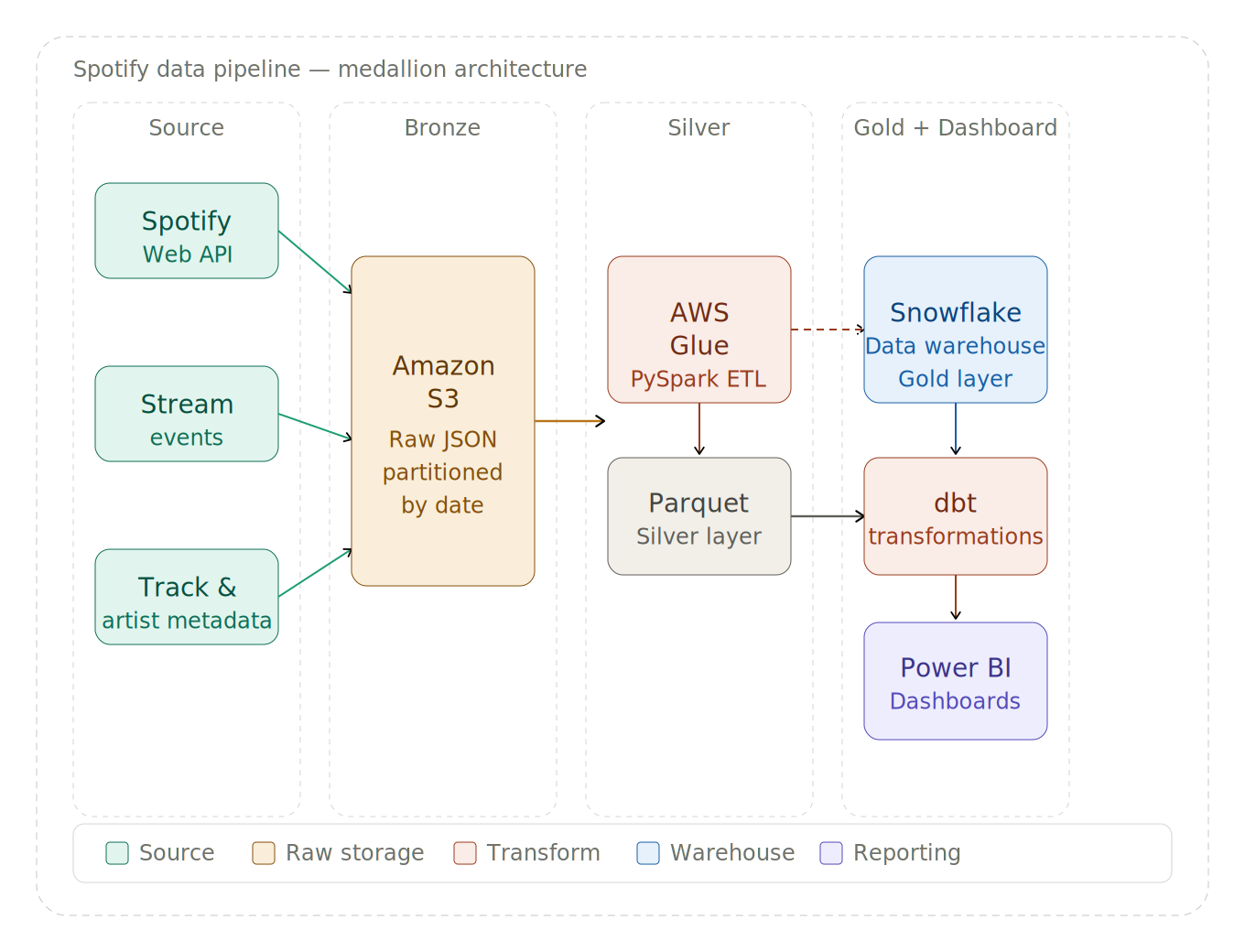
Spotify Data Pipeline with AWS Glue, Snowflake & Power BI
An end-to-end data pipeline that ingests Spotify streaming data via the Spotify API, stages it …
View Project
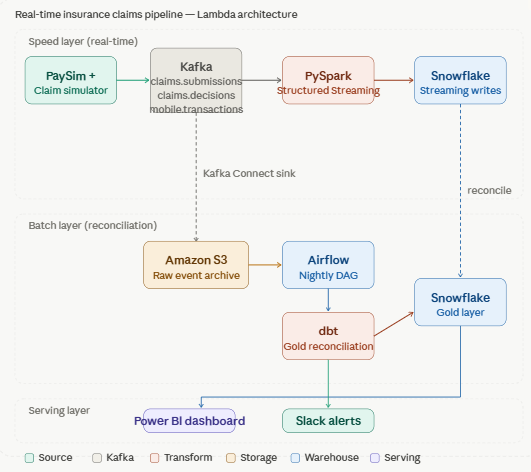
An end-to-end real-time streaming pipeline that ingests synthetic mobile money and insurance claim events (PaySim + custom claim simulator), publishes them to Apache Kafka topics, processes with PySpark Structured Streaming, loads into Snowflake, and delivers a live Power BI dashboard tracking claim volumes, fraud flags, and payout velocity across African markets.
import json
import random
import time
import uuid
from datetime import datetime, timezone
from kafka import KafkaProducer

KAFKA_BOOTSTRAP = "localhost:9092"
TOPICS = {
    "purchase":   "claims.submissions",
    "submission": "claims.submissions",
    "decision":   "claims.decisions",
}
PRODUCTS   = ["life_basic", "hospital_cash", "accident", "funeral"]
MARKETS    = ["KE", "UG", "TZ", "GH", "NG"]
DECISIONS  = ["approved", "rejected", "pending_review"]
FRAUD_RATE = 0.003  # 0.3% fraud injection rate

producer = KafkaProducer(
    bootstrap_servers=KAFKA_BOOTSTRAP,
    value_serializer=lambda v: json.dumps(v).encode("utf-8"),
    key_serializer=lambda k: k.encode("utf-8"),
)


def make_policy_event() -> dict:
    policy_id  = f"POL-{uuid.uuid4().hex[:10].upper()}"
    customer_id = f"CUST-{random.randint(10000, 99999)}"
    return {
        "event_id":     str(uuid.uuid4()),
        "event_type":   "policy_purchase",
        "policy_id":    policy_id,
        "customer_id":  customer_id,
        "product":      random.choice(PRODUCTS),
        "market":       random.choice(MARKETS),
        "premium_kes":  round(random.uniform(50, 500), 2),
        "is_fraud":     random.random() < FRAUD_RATE,
        "timestamp":    datetime.now(timezone.utc).isoformat(),
    }


def make_claim_event(policy_id: str, customer_id: str) -> dict:
    is_fraud = random.random() < FRAUD_RATE
    return {
        "event_id":     str(uuid.uuid4()),
        "event_type":   "claim_submission",
        "claim_id":     f"CLM-{uuid.uuid4().hex[:10].upper()}",
        "policy_id":    policy_id,
        "customer_id":  customer_id,
        "claim_amount": round(random.uniform(500, 50000), 2),
        "is_fraud":     is_fraud,
        "fraud_reason": "rapid_successive_claim" if is_fraud else None,
        "timestamp":    datetime.now(timezone.utc).isoformat(),
    }


def make_decision_event(claim_id: str) -> dict:
    return {
        "event_id":   str(uuid.uuid4()),
        "event_type": "claim_decision",
        "claim_id":   claim_id,
        "decision":   random.choice(DECISIONS),
        "decision_by": "auto_rules_engine",
        "payout_kes": round(random.uniform(500, 50000), 2),
        "timestamp":  datetime.now(timezone.utc).isoformat(),
    }


def run(events_per_second: int = 50):
    print(f"Producing {events_per_second} events/sec...")
    active_policies = []

    while True:
        for _ in range(events_per_second):
            # Policy purchase
            policy = make_policy_event()
            active_policies.append(policy)
            producer.send(
                TOPICS["purchase"],
                key=policy["policy_id"],
                value=policy,
            )

            # Randomly submit a claim against an existing policy
            if active_policies and random.random() < 0.3:
                p = random.choice(active_policies)
                claim = make_claim_event(p["policy_id"], p["customer_id"])
                producer.send(
                    TOPICS["submission"],
                    key=claim["claim_id"],
                    value=claim,
                )

                # Immediately produce a decision 40% of the time
                if random.random() < 0.4:
                    decision = make_decision_event(claim["claim_id"])
                    producer.send(
                        TOPICS["decision"],
                        key=decision["claim_id"],
                        value=decision,
                    )

        producer.flush()
        # Cap active policies list to avoid unbounded memory growth
        if len(active_policies) > 10_000:
            active_policies = active_policies[-5_000:]

        time.sleep(1)


if __name__ == "__main__":
run(events_per_second=100)from pyspark.sql import SparkSession
from pyspark.sql import functions as F
from pyspark.sql.types import (
StructType, StructField, StringType,
DoubleType, BooleanType, TimestampType
)
KAFKA_BOOTSTRAP = "localhost:9092"
SNOWFLAKE_OPTIONS = {
"sfURL": "{ACCOUNT_NAME}",
"sfUser": "{USER}",
"sfPassword": "{PASSWORD}",
"sfDatabase": "INSURANCE_DB",
"sfSchema": "STREAMING",
"sfWarehouse": "CLAIMS_WH",
}
spark = SparkSession.builder \
.appName("InsuranceClaimsStreaming") \
.config("spark.jars.packages",
"org.apache.spark:spark-sql-kafka-0-10_2.12:3.4.0,"
"net.snowflake:spark-snowflake_2.12:2.12.0-spark_3.4") \
.getOrCreate()
spark.sparkContext.setLogLevel("WARN")
# --- Schema for claim submission events ---
claim_schema = StructType([
StructField("event_id", StringType(), False),
StructField("event_type", StringType(), True),
StructField("claim_id", StringType(), True),
StructField("policy_id", StringType(), True),
StructField("customer_id", StringType(), True),
StructField("claim_amount", DoubleType(), True),
StructField("is_fraud", BooleanType(), True),
StructField("fraud_reason", StringType(), True),
StructField("timestamp", TimestampType(), True),
])
# --- Read from Kafka ---
raw_stream = spark.readStream \
.format("kafka") \
.option("kafka.bootstrap.servers", KAFKA_BOOTSTRAP) \
.option("subscribe", "claims.submissions,claims.decisions") \
.option("startingOffsets", "latest") \
.option("maxOffsetsPerTrigger", 10_000) \
.load()
# --- Parse JSON payload ---
parsed = raw_stream.select(
F.from_json(
F.col("value").cast("string"), claim_schema
).alias("data"),
F.col("timestamp").alias("kafka_timestamp"),
).select("data.*", "kafka_timestamp")
# --- Fraud scoring: flag high-velocity claimants ---
windowed = parsed \
.withWatermark("timestamp", "2 minutes") \
.groupBy(
F.window("timestamp", "1 hour", "10 minutes"),
F.col("customer_id"),
) \
.agg(
F.count("claim_id").alias("claims_in_window"),
F.sum("claim_amount").alias("total_claimed"),
F.max("is_fraud").alias("any_fraud_flag"),
) \
.withColumn(
"velocity_fraud_flag",
F.col("claims_in_window") > 3
) \
.withColumn("window_start", F.col("window.start")) \
.withColumn("window_end", F.col("window.end")) \
.drop("window")
# --- Write micro-batches to Snowflake ---
def write_to_snowflake(batch_df, batch_id):
if batch_df.isEmpty():
return
batch_df.write \
.format("net.snowflake.spark.snowflake") \
.options(**SNOWFLAKE_OPTIONS) \
.option("dbtable", "FACT_CLAIM_VELOCITY") \
.mode("append") \
.save()
print(f"Batch {batch_id}: wrote {batch_df.count()} rows to Snowflake")
query = windowed.writeStream \
.foreachBatch(write_to_snowflake) \
.outputMode("update") \
.trigger(processingTime="30 seconds") \
.option("checkpointLocation", "/tmp/checkpoints/claims_velocity") \
.start()
query.awaitTermination()from datetime import datetime, timedelta
from airflow import DAG
from airflow.operators.python import PythonOperator
from airflow.operators.bash import BashOperator
from airflow.providers.slack.operators.slack_webhook import SlackWebhookOperator
from airflow.models import Variable
import snowflake.connector
default_args = {
"owner": "data_engineering",
"retries": 2,
"retry_delay": timedelta(minutes=5),
"email_on_failure": True,
"email": ["data-alerts@bidabi.com"],
}
SNOWFLAKE_CONN = {
"account": Variable.get("SNOWFLAKE_ACCOUNT"),
"user": Variable.get("SNOWFLAKE_USER"),
"password": Variable.get("SNOWFLAKE_PASSWORD"),
"database": "INSURANCE_DB",
"warehouse": "CLAIMS_WH",
"schema": "GOLD",
}
with DAG(
dag_id="insurance_claims_nightly_reconciliation",
default_args=default_args,
description="Nightly batch reconciliation for the streaming claims pipeline",
schedule_interval="0 1 * * *", # 1 AM daily
start_date=datetime(2025, 1, 1),
catchup=False,
tags=["insurance", "reconciliation", "streaming"],
) as dag:
# Step 1: Run dbt models to rebuild Gold layer from S3 raw events
run_dbt_models = BashOperator(
task_id="run_dbt_gold_models",
bash_command=(
"cd /opt/dbt/insurance && "
"dbt run --select tag:gold --target prod "
"--vars '{run_date: {{ ds }}}'"
),
)
# Step 2: Run dbt tests on Gold models
run_dbt_tests = BashOperator(
task_id="run_dbt_tests",
bash_command=(
"cd /opt/dbt/insurance && "
"dbt test --select tag:gold --target prod"
),
)
# Step 3: Reconcile streaming vs batch counts
def reconcile_counts(**context):
run_date = context["ds"]
conn = snowflake.connector.connect(**SNOWFLAKE_CONN)
cur = conn.cursor()
# Streaming count from micro-batch writes
cur.execute(f"""
SELECT COUNT(*) FROM STREAMING.FACT_CLAIM_VELOCITY
WHERE DATE(window_start) = '{run_date}'
""")
streaming_count = cur.fetchone()[0]
# Batch count from dbt Gold model
cur.execute(f"""
SELECT COUNT(*) FROM GOLD.FACT_CLAIM_EVENTS
WHERE DATE(event_timestamp) = '{run_date}'
""")
batch_count = cur.fetchone()[0]
if batch_count == 0:
raise ValueError(f"No batch records found for {run_date}")
discrepancy_pct = abs(streaming_count - batch_count) / batch_count * 100
context["ti"].xcom_push(key="discrepancy_pct", value=discrepancy_pct)
context["ti"].xcom_push(key="streaming_count", value=streaming_count)
context["ti"].xcom_push(key="batch_count", value=batch_count)
print(f"Streaming: {streaming_count} | Batch: {batch_count} | "
f"Discrepancy: {discrepancy_pct:.4f}%")
if discrepancy_pct > 0.1:
raise ValueError(
f"Discrepancy {discrepancy_pct:.4f}% exceeds 0.1% threshold"
)
cur.close()
conn.close()
reconcile = PythonOperator(
task_id="reconcile_streaming_vs_batch",
python_callable=reconcile_counts,
)
# Step 4: Slack alert on success
notify_success = SlackWebhookOperator(
task_id="notify_success",
slack_webhook_conn_id="slack_data_alerts",
message=(
":white_check_mark: *Insurance Claims Reconciliation* passed for "
"{{ ds }}.\n"
"Streaming: {{ ti.xcom_pull(task_ids='reconcile_streaming_vs_batch', key='streaming_count') }} | "
"Batch: {{ ti.xcom_pull(task_ids='reconcile_streaming_vs_batch', key='batch_count') }} | "
"Discrepancy: {{ ti.xcom_pull(task_ids='reconcile_streaming_vs_batch', key='discrepancy_pct') | round(4) }}%"
),
trigger_rule="all_success",
)
run_dbt_models >> run_dbt_tests >> reconcile >> notify_successAn end-to-end data pipeline that ingests Spotify streaming data via the Spotify API, stages it …
View Project